The Kettle Doesn't Lie: What Office Rituals Can Tell You About Burnout
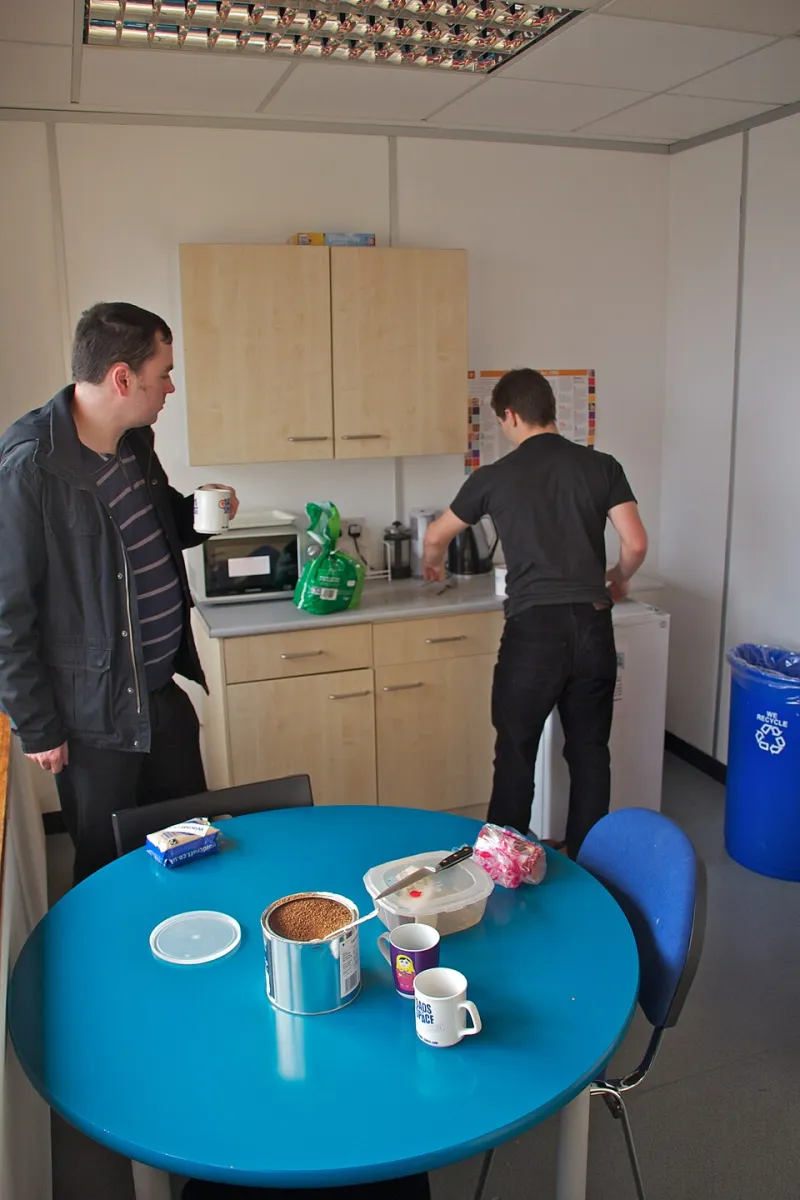
Photo: Photograph by Mike Peel (www.mikepeel.net)., CC BY-SA 4.0, via Wikimedia Commons
Every office has its own small choreography. Someone does a lap with the mug tree. Someone else texts the group chat about a lunchtime walk. On Fridays, a handful of people drift towards the same corner to decompress before the weekend. None of it looks like wellbeing support. It is not a policy, a workshop or a laminated poster by the kettle. But these low-stakes rituals are often the most honest gauge of how a team is really doing.
When a colleague quietly stops joining in — not once, because they are busy, but again and again — it is worth noticing. Not because they owe anyone a brew, but because withdrawal from ordinary social contact is one of the earlier, quieter signals that something may be running low.
The rituals that hold a team together
The tea round gets mocked, but it is doing more than caffeine delivery. It is a rolling census. Who is at their desk? Who has their headphones on? Who usually says yes and who has started saying nothing at all? A lunch walk does something similar: it creates a low-pressure space where people can talk sideways rather than face to face. The Friday debrief, whether it is a pub visit or a ten-minute chat about the week, gives people a container for the stuff that does not fit in a project update.
These routines matter because they are optional. That is their strength. They are not a mandatory fun session or a team-building away day. They are small, repeatable chances to be around other people without having to perform.
So when someone drops out of them, it can be easy to misread. Maybe they are just busy. Maybe they have a new routine. Maybe they have decided they do not like the pub. All of those things can be true. But a pattern of withdrawal — especially alongside other changes like shorter replies, skipped breaks or a flatter tone — is worth a second look.
The quiet signal in a missed brew
Burnout does not usually arrive with a dramatic announcement. It tends to show up in small edits to behaviour. The person who once remembered everyone's order stops asking. The one who organised the lunch walk becomes the one who stays at their desk. The Friday debrief regular quietly disappears, and nobody can remember exactly when it started.
From the outside, it can look like a personality change. From the inside, it often feels like there is nothing left over. Social contact takes energy. Even the good, easy kind. When someone is running on empty, the tea round can feel like one more task on a list that is already too long.
That does not mean every quiet colleague is burned out. It means the change is worth a gentle, non-diagnostic conversation. Think of it as a smoke alarm, not a verdict.
Why withdrawal happens before the words
People often pull back before they speak up. There are plenty of reasons. They might not have the language for what is happening. They might worry that saying 'I am struggling' will change how they are seen. They might be the person everyone relies on, and admitting they need something feels like letting the side down.
In UK workplaces, there is also the stiff-upper-lip reflex. We are often very good at saying 'I'm fine' and very bad at believing each other. That is why the small rituals matter. They give people a way to stay connected without having to explain themselves. And when someone steps out of them, they give the rest of us something concrete to notice.
Don't turn it into forced fun
The worst response to a withdrawn colleague is to drag them into a compulsory social event and call it support. Forced fun rarely helps. It can feel like another performance, another thing to manage, another room in which to say 'I'm fine'.
The aim is not to make someone join the tea round. It is to make sure they know the door is still open. There is a difference between 'You never come to Friday drinks anymore' and 'I've noticed you've been keeping to yourself — no pressure, but I'm around if you want a chat'. One feels like an accusation. The other feels like an invitation.
A gentle three-step check-in
If you are a manager or a colleague and you have noticed a pattern, keep it simple. You are not trying to diagnose anyone. You are trying to be a human being who has seen another human being.
1. Notice the pattern, not the one-off
One missed tea round is not a red flag. A run of missed lunches, quieter messages and a general stepping back from the team is more worth acting on. Make a mental note of what has changed, and when. This helps you avoid projecting a story onto someone. It also means you can describe what you have seen without sounding vague.
2. Invite without pressure
Choose a low-stakes moment. A short walk, a coffee, a chat away from the main desk. Keep the invitation easy to decline. Something like: 'I'm going for a brew in a bit — want to join? Totally fine if not.' The point is not the brew. The point is the option.
If you are a manager, you might say: 'I've noticed you've been a bit quieter lately and you've not been on the lunch walk. No need to explain anything now, but I wanted to check how you're doing.' Then stop talking. Let them decide how much to share.
3. Follow through with something practical
A check-in that ends with 'let me know if you need anything' is well-meant but often empty. Follow through with something specific. Ask whether a deadline can move. Offer to take one thing off their plate. Ask if they want to talk to someone outside the team. If your organisation has an employee assistance programme or occupational health support, point to it plainly and without shame.
The follow-through matters because burnout is not solved by a single cup of tea. It is solved by reducing the load, restoring some control and making support real rather than rhetorical.
Small rituals, human signals
The tea round is not a test anyone has to pass. It is a small, ordinary way of staying in touch with each other. But it can be a useful early warning system. When the kettle goes quiet, or the lunch walk loses a regular, or the Friday debrief becomes a solo activity, it is worth asking a gentle question.
Not 'why are you being antisocial?' Not 'we're doing a team social, it'll be fun'. Just: 'I've noticed. I'm here.' Sometimes that is the first crack of light in a very long week.